International Exposure and Extra-Curricular Activities
Muqtasid has always been a person with multiple interests. In addition to focusing heavily on his core passion, physical fitness, maintaining decent performance in academics, and carving out time for social work, he has also participated in many extracurricular activities within India and even abroad. This page captures his enabling and insightful experiences of his participation in the following engagements:
Summer courses in reputed international universities
Penn Summer Course 2025 – University of Pennsylvania
In the summer of 2025, Muqtasid, a Grade 11 student from India, had the opportunity to attend the Penn Summer Prep Program at the University of Pennsylvania, an Ivy League institution renowned for its academic excellence and global outlook. The program allowed ambitious students from across the world to enroll in undergraduate-level modules, gain exposure to world-class teaching, and immerse themselves in Penn’s vibrant campus life in Philadelphia.
Across two intensive weeks, Muqtasid explored subjects that combined leadership, innovation, and cutting-edge data science, reflecting both his diverse interests and his drive to connect knowledge with real-world challenges.
Module 1: Developing the Leader Within
Instructor: Mr. Wayne Tarken
Course Details »
This interactive leadership course focused on cultivating the skills required to inspire, collaborate, and problem-solve in dynamic environments. Through engaging exercises—such as building spaghetti towers and testing paper bridges with weights—Muqtasid and his peers learned the value of teamwork, resilience, and creative thinking.
The program culminated in each participant delivering a TED-style talk, where Muqtasid showcased his ability to communicate with confidence and clarity. His reflections on leadership emphasized adaptability, empathy, and the courage to lead with purpose.
Module 2: Big Data, Big Change – Understanding Climate with Data Science
Instructor: Dr. Xueke Li
Course Details »
In this multidisciplinary module, Muqtasid studied how big data can be harnessed to address climate change. He developed hands-on skills with Python programming, data visualization (using Matplotlib), and Google Earth storytelling.
Working in a team project, Muqtasid focused on storms across the United States, analyzing historical storm data to identify patterns and predict future trends. This experience was particularly meaningful, as it built on his earlier independent research in Grades 9–10, where he investigated the impact of space weather conditions on rocket launches. By applying Python-based data models to factors such as solar proton/electron flux, sunspot activity, and atmospheric variables, he had previously developed a framework to estimate rocket launch success probabilities.
The Penn course not only deepened his technical knowledge of climate science and meteorology, but also allowed him to connect his past space-weather research with broader environmental challenges—reinforcing his passion for using science and data to solve critical global problems.
Reflections
The Penn Summer Prep Program was a transformative milestone in Muqtasid’s academic journey. By engaging with students and faculty from around the world, he experienced the richness of college-level academics in an Ivy League environment while sharpening his leadership, research, and analytical skills.
This experience has further inspired Muqtasid to pursue a path where science, technology, and leadership intersect, with the goal of driving meaningful impact on a global scale.
Certificate of this course is available here --> https://certificates-hsprogs.sas.upenn.edu/4d456915-5f65-4a6a-b7c7-5511fb7a0f81#acc.HFozqAXE
Summer Course - Institute for High Energy Physics in Barcelona, Spain
In 2023, Muqtasid participated in a two-week residential summer research program hosted by the Institute for High Energy Physics in Barcelona, Spain. During this immersive experience, Muqtasid had the unique opportunity to build a muon detector and explore the fascinating world of particle physics. Muqtasid learnt about the interaction of particles with matter, the creation and destruction of particles in the atmosphere, the phenomenon of particle showers, and the inner workings of particle detectors. This experience not only deepened his passion for scientific inquiry but also instilled in me a desire for more intense academic and research pursuits. Details of Muqtasid’s summer 2024 experience is as follows.
Star explosions, black holes, and even the sun release particles and energy that fall under the category of cosmic rays. Upon striking the atmosphere, a shower of new particles is generated, including Muons, which Muqtasid detected by building a special circuit at the Barcelona International Youth Science Challenge, or BIYSC. Here’s a brief journey of the project.
Starting off with theory, it was understood that Muons pass through everything, hence can’t be detected directly. However, a material called ‘scintillator’ glows (releasing light) when Muons pass through it. The Muons travel through it, passing their energy to all electrons in atoms they encounter along the way. These electrons jump up to a high energy level, then come back down, releasing this energy in the form of light, which is what we actually detect.
Muons also decay quite fast for them to reach the ground, however, Muqtasid learnt that due to time dilation, they “experience time slowly” from our perspective, hence they decay after longer, allowing them to reach us. From the Muons perspective, the distance to the ground seems shorter. Basically weird stuff happens when going really fast, hence they can reach us. Muqtasid was able to recall the derivation for the equation that explains this using a simple example, which I shared with others.
Afterwards, Muqtasid’s team designed the circuit. The plan was to have a circuit board, on top of which we have a silicon PM(photo-multiplier), a fancy word for light detector. They cut out the plastic scintillator with the right size, to later place on top of the PM. We then build a circuit with a bunch of resistors, capacitors and wires, connected to an output that leads to a machine that graphs voltage as a function of time(oscilloscope). In the end they covered all of this with a box that allows no external light in, and that's it.
What this basically does is, a Muon would pass through the detector, causing the scintillator inside to release light. The PM detects this light, and an electric signal is generated, which is shown by the oscilloscope.
They built the circuit, connecting components with wires, and soldering(melting metal to join components strongly) certain points. A picture of our circuit is shown here:
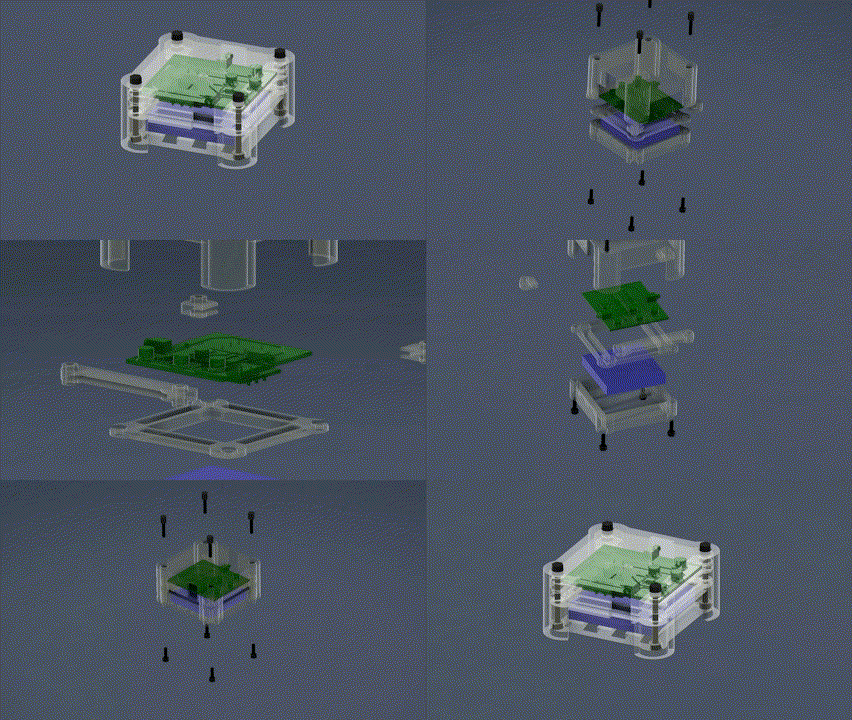
They designed parts of the outer box that would enclose the circuit, holding it together and allowing no light in.
This is the image of the oscilloscope. The peak you see is an electric signal received by the detector. This means it detected a Muon.
Remember, they enclosed their detector within a box that allows no external light, because they only wanted the PM to detect light from the scintillator.
To figure out the impact of the sun on the number of Muon detections, they pointed 2 detectors stacked on top of each other directly at the sun and certain angles away from it, observing the Muon count. They used 2 detectors so that we would only consider 2 peaks on the scope as a Muon, since it is possible for one detector to send a signal to the scope due to nearby electromagnetic noise, even though no Muon passed through. Using 2 detectors reduces the chances of such false positives. They made the setup to hold detectors stacked on top of each other at different angles. Here is a picture of their group experimenting and the sample results.
To automate the process of looking at the scope and counting the peaks, Muqtasid had an interesting Idea. Although it wasn’t implemented fully by the end, they could make it work to a certain extent.
They’d got two detectors, so the scope will plot the voltage as a function of time for 2 signals from the 2 detectors. When they get a peak for both at the same time, that's a Muon.
They took a video of the oscilloscope screen, and then developed the following code.
This code performs the following steps:
1. Splits the frames of the video
2. Goes through each frame
3. Checks all the pixels along a specific minimum height, above which if the plot goes, it’s counted as a peak
They had to do the third step for the blue line and the yellow line. The minimum height for the yellow would be a little less than for the blue, since the detector corresponding to the yellow line usually produced a weaker signal.
What they saw above is the,
Line 1- An empty list is made
Line 2- The code is going to go through each frame
Line 3- The code goes through every pixel along the minimum height for the yellow peak, and if it finds a certain number of pixels with the color of the yellow line, it means the yellow line must have crossed that height, hence it counts it as a yellow peak.
Then, the code goes through every pixel along the minimum height for the blue peak, and if it finds a certain number of pixels with the color of the blue line, it means the blue line must have crossed that height, hence it counts it as a blue peak.
Line 4- When both these peaks are detected in the frame, 1 is added to the empty list at the start, else 0 is added.
In the end, they had something like this:
In this big list, each 0 or 1 corresponds to a frame in the video, 1 meaning the frame has both peaks, 0 meaning it does not.
Everytime peaks show up, they remain for about half a second, that means the one incident of both the peaks showing up together would remain for many frames. So to count the peaks, here’s the final step.
4. Count number of simultaneous peaks from list
The code goes through the list and counts a group of 21 or more back to back 1’s as a single simultaneous peak, considering back to back 1’s as 1’s with a gap of less than two 0’s in between.
The result:
The code was tested on small samples of 1 minute, however, certain issues were faced with large recordings like the one’s required for the experiment we performed. Due to time constraints the code was not implemented on large recordings, however, it was certainly amazing to see peaks getting counted automatically even for small samples, with a code written in such a short amount of time.
Certificate //TODO
LOR //TODO




Creating short hilarious skits (story + direction) for pure entertainment purposes
One fun fact is during childhood, Muqtasid loved Theatrical Activities like conceiving ideas for short hilarious skits, writing scripts, providing directions to the actors, playing the main role himself, polishing and fine tuning videos and publishing them on a YouTube channel. He had fun recording, editing and posting these videos, and his friends and family really enjoy watching these. He had a fair fan following for these videos, in the form of 134 subscribers of the youtube channel and a few videos with more than 500 views